Small Goals for a Big Violin Year
By Pablo Fayad
A great violin year isn’t built on heroic achievements, but on small decisions sustained over time.
As the year comes to an end and we reflect on our progress, it’s worth taking a moment to acknowledge our victories and prepare consciously for the year ahead. Each new year offers an opportunity to begin — or renew — a practice of self-awareness and organization.
I believe one of the main goals violinists share is to make practice continuous and sustainable, rather than sporadic and intense. How can we achieve continuity and sustainability? Paradoxically, by breaking that big goal into small, manageable parts.
In this article, I propose approaching this idea through self-awareness, structured around three main topics:
- Self-evaluation to know yourself better
- Small daily strategies to support the year
- Working on Sustainable Progress
Self-Evaluation to Know Yourself Better
We are often taught to fear mistakes and criticism. However, the ability to self-evaluate, identify errors, and work on them is essential for progress.
Self-evaluation is a complex and valuable skill. Although it is subjective — since we evaluate ourselves — it complements the teacher’s work and helps develop autonomy and professionalism. Conscious self-evaluation allows us to step back and observe ourselves from a perspective where ego does not interfere with reality.
It can be applied on technical, musical, and personal levels to identify weaknesses and decide where to focus our energy.
To evaluate ourselves effectively, we must first understand the role of error. An error is simply a way of doing something that does not meet certain standards and therefore creates a limitation. When read correctly, errors become useful information that shows us what to work on next.
Many musicians fear evaluation — not only because of personal insecurities, but because we often come from systems where mistakes are treated as failures rather than feedback. When we shift that mindset, self-evaluation becomes a powerful tool.
An Example of Self-Evaluation
As the year ends, many violinists (and musicians in general) take stock. Often, we do this harshly — comparing ourselves to others or focusing only on what we didn’t achieve. This proposal is different: a kind, clear, and concrete self-evaluation, designed to help you understand where you are and where you want to go — not to punish yourself.
The idea is to divide the reflection into two interconnected dimensions: technical-musical and psychological-emotional. And a third part of Three Concrete Achievements of the Year. We can also use trigger or starter phrases to help us.
Closing the Self-Evaluation
This self-evaluation is not an exam. It is an honest snapshot of a moment along the path. A violinist is not built in a year, but the relationship with the instrument can change.
Starting a new year doesn’t always mean doing more — sometimes it means seeing more clearly what we’ve already done and mature our behaviour.
You can make this evaluation more structured or more open-ended. Some people write a letter to themselves; others share reflections with teachers or colleagues. What matters most is approaching the process with kindness and acknowledging yourself for being on this path.
Small Daily Strategies
After self-evaluation, let’s move into a set of tools that can support us throughout the year. Imagine a toolbox filled with resources. Today, we’ll focus on small but powerful techniques.
Step-by-Step as a Psychological Technique (Scaffolding)
The “step-by-step” approach — also known as scaffolding — is especially helpful when starting feels difficult. It’s simple, effective, and highly applicable to violin practice, particularly when anxiety or mental overload appears.
Instead of thinking about everything we need to do, we focus on one single action: opening the case, holding the violin, setting our posture, playing open strings, reading a few measures.
Its strength lies in bringing us back to the present moment and preventing overwhelm. On a micro level, it also helps us break down complex material and understand it with greater clarity.
Micro-Practice Sessions
Long practice sessions can feel intimidating. Micro-practice sessions — short, focused periods — help reduce resistance and build consistency.
A key principle (often overlooked) is that ending is as important as starting. Continuing beyond the planned time may feel productive, but it’s rarely sustainable long-term.
The goal is to maintain the habit.
Drones
Technology can greatly enhance awareness. A simple drone pitch, metronome, or short recording can bring depth to daily practice.
Use these tools sparingly. Consistency matters more than intensity.
Example: incorporate drones into scale and arpeggio practice to improve intonation and listening.
A Personal Violin Journal
A violin journal is an excellent tool for tracking progress and releasing frustration. It can evolve over time — from structured notes to free expression.
Possible formats:
- Practice routine journal
- Positive feedback journal
- Free expression journal
- Technical and musical ideas journal
Make it fun and creative. This is a judgment-free space and we are all looking to improve by creating good habits. But mainly enjoying what we do! Can you think of any other micro strategy?
Working on Sustainable Progress
As we close, let us reflect on one of the central challenges in violin practice: sustaining progress through consistency. This is not an easy task. It invites many approaches and remains deeply personal — what proves effective for one musician may not suit another. I suggest embracing it as a continuous movement: experiment with one approach for a week, then reassess or adjust the following week. Step by step, you will shape a method that is truly your own.
But let me ask you a question:
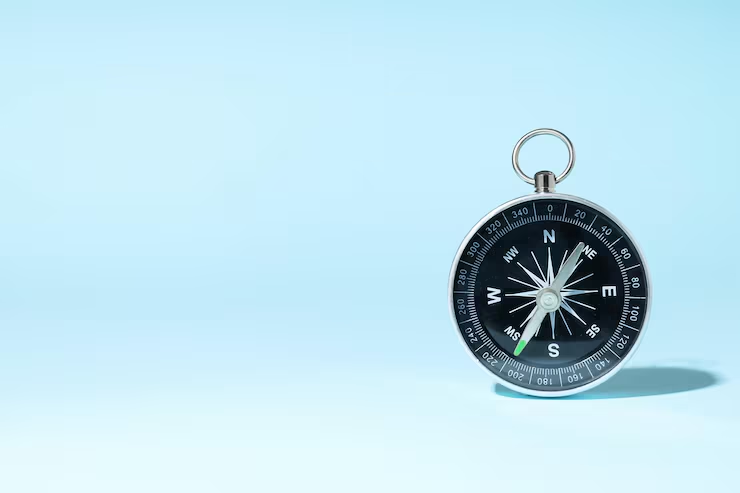
Do we need a detailed map, or a compass to guide us?
For violinists, this metaphor is particularly powerful.
The map represents planning: repertoire, scales, studies, deadlines, exams, concerts. It provides structure.
The compass, however, represents intuition — especially when the map no longer feels right. Many musicians distrust intuition, mistaking it for laziness. But intuition is not a lack of discipline; it’s a refined form of musical, emotional, and bodily intelligence.
- Map without compass → progress without meaning
- Compass without map → inspiration without execution
The balance lies in allowing them to dialogue. The map can be redrawn. The compass reminds us why we walk. Maybe this year you don’t need a perfect plan — but a clearer sense of direction.
How to develop these skills?
To develop the skills of the map and the compass, we need, on the one hand, trial and error. We draw a map and make mistakes. But above all, we need a teacher who can share their methodology, so we can test it and refine it. Professional training is essential to avoid falling into the illusion of “magical progress.”
There is an overwhelming amount of information about study and improvement. Sometimes it’s simply too much. This is where we can apply a filter: choose one way to organize ourselves — whether it’s a calendar, a journal, a whiteboard, or something else. Try it for a period of time, then evaluate what works and what doesn’t.
The map and the compass are starting points, not organizational methods in themselves. The map suits those who need more structure, serving as a guide that outlines the aspects to address in their routine. The compass is better for those with more experience, who can self-assess and decide what they need depending on their short- and long-term goals.
Examples of the map and the compass
Map Strategy (structured, planned approach)
- Weekly Plan: Monday scales, Tuesday arpeggios, Wednesday études, Thursday repertoire, Friday review.
- Clear milestones: “By the end of the month, I will master second position shifts in two pieces.”
- Tools: Calendar, practice journal, or whiteboard to track progress.
- Benefit: Provides security and clarity, especially for beginners or those who feel overwhelmed.
Compass Strategy (intuitive, flexible approach)
- Daily choice: Sit down and ask, “What feels most necessary today?” Maybe bow control one day, vibrato the next.
- Guided by listening: Record yourself briefly, notice what needs attention, and let that guide the session.
- Emotional connection: Choose fragments of repertoire that resonate emotionally and work on expression.
- Benefit: Encourages autonomy and creativity, better suited for experienced players who can self-assess.
You might also use a map to set the week’s structure (e.g., scales every morning, repertoire in the afternoon), but rely on the compass to decide which specific technical issue or musical phrase deserves extra focus that day. That’s totally up to you!
How to Track Progress Without Frustration
One of the biggest challenges in violin practice isn’t lack of progress — it’s failing to notice it.
a. The 10-Second Before/After Recording
Short, honest recordings reveal changes we don’t feel while playing.
b. Weekly Micro-Reflections
Small reflections prevent the pressure of massive evaluations.
c. Celebrating Invisible Progress
Patience, focus, reduced resistance, and honesty are also progress.
The cherry on top of the cake… Rest!
Maybe it’s just me, but isn’t resting one of the best feelings after you’ve worked hard, put in effort, and noticed progress? Taking pauses and enjoying time away from the instrument is essential. And it’s important to really enjoy that time — not suffer in silence because you think you “should” be practicing.
On a serious note, the benefits of rest are well documented. Rest helps our neurons form new connections, prevents injuries, strengthens our muscles, and restores our energy and stamina. If we struggle to rest, or if we rest in tension, we miss out on these benefits. In a way, we are cultivating a harmful relationship with hour instrument.
A healthy routine includes rest periods, and it’s crucial to respect them — even when you feel the energy to keep playing. Rest is not a weakness; it’s part of sustainable progress.
Conclusion
As this journey comes to a close, it’s worth remembering that violin practice — like life — is not about reaching grand destinations, but about cultivating small daily victories.
Self-evaluation helps us look back with clarity and compassion. Small strategies sustain consistency. And intuition, as a compass, guides us when the map feels unclear.
The violin is more than an instrument — it’s a companion. Next year is not about doing more, but about doing better: with more awareness, more intention, and more heart.